
Top Ten Appellate Mistakes – Failing to Tell the Judges Why They Should Care

15190238 - illustration depicting a roadsign with aMany attorneys who believe that they have controlling precedent on their side gleefully approach appellate briefs with the strong conviction that an appeal to the law will cause truth and justice to rain down and the trial court’s incorrect decision to be swept away in the ensuing deluge. The simple truth, however, is that courts follow their own precedents only when they care to do so. If a court doesn’t like your client, your case or even you, it will ignore your arguments, no matter how compelling. This fact should force you to consider how to make the court want to follow its precedents or, if the law is against you, ignore them.

In the words of the Seventh Circuit:

Where possible, the emphasis should be on reason, not merely on precedent, unless a particular decision is controlling. A few good cases on point, with a sufficient discussion of their facts to show how they are relevant, are preferred over a profusion of citations.

Practitioner’s Handbook for Appeals to the United States Court of Appeals for the Seventh Circuit, § XXII (2014 Edition) (Emphasis added). In the words of one commentator, “What this means, of course, is that judges, especially appellate judges, will do what they damn well please.” Ralph Adam Fine, The “How-To-Win” Appeal Manual, p. 1 (2000).

To do this, you should invite the court to look at the bigger picture. Here are several suggestions:


  1. Remind the court why the rule, statute or governing precedent existed in the first place:

Plaintiff contends that his suit for intentional infliction should proceed even in the absence of a physical manifestation of that distress. The Court should not consider his expansive theory because the law permits recovery in the most unusual circumstances when a plaintiff’s distress is severe. Hoy v. Angelone, 456 Pa. Super. 596, 691 A.2d 476, 482 (1997). If no physical manifestation were required, then juries might award damages for only fleeting and unverifiable distress.


  1. Appeal to the court’s reluctance to create new causes of action or new defenses never before recognized:

 The premise of all these claims is that the University and its administrators had a legal obligation to protect plaintiffs from the consequences of a police investigation—by quelling media coverage of the case, preventing campus protests, and even interceding to stop the investigation. That premise is invalid, and the Complaint should be dismissed.


Carrington v. Duke University.


  1. Appeal to the court’s desire to do the right thing:


As the Commission explained, the F-Word is effective when used to intensify or insult precisely because it has an offensive sexual connotation.  Moreover, fine points of the distinctions between denotations and connotations may be lost on children seeking an explanation of the word’s meaning from their parents.

 FCC v. Fox.


  1. Warn the court that it should not go down a “slippery slope.” If necessary, create a “parade of horribles”:

The anti-solicitation ordinance under review bars individuals from “stand[ing] on a street or highway and solicit[ing], or attempt[ing] to solicit, employment, business, or contributions from an occupant of any motor vehicle.” If this Court were to uphold the ordinance, the City could use it to prosecute:

  • children selling lemonade on the sidewalk in front of their home,
  • Girl Scouts selling cookies on the sidewalk outside of their school,
  • school children shouting “carwash” at passing vehicles,
  • university students imploring donations to disaster relief funds,
  • signbearers on sidewalks seeking patronage or offering handbills even though their conduct does not pose a traffic hazard,
  • sidewalk food vendors from advertising their wares to passing motorists,
  • a motorist who stops, on a residential street, to inquire whether a neighbor’s teen-age daughter or son would be interested in performing yard work or babysitting.


Notice the use of the “broccoli horrible”:

An individual’s decision to self-insure, I have explained, is an economic act with the requisite connection to interstate commerce. [citation omittted] Other choices individuals make are unlikely to fit the same or similar description. As an example of the type of regulation he fears, The Chief Justice cites a Government mandate to purchase green vegetables. [citation omitted] One could call this concern “the broccoli horrible.” Congress, The Chief Justice posits, might adopt such a mandate, reasoning that an individual’s failure to eat a healthy diet, like the failure to purchase health insurance, imposes costs on others.

Nat’l Fed’n of Indep. Bus. v. Sebelius, 132 S. Ct. 2566, 2624 (U.S. 2012)

For more information on the “slippery slope” and “parade of horribles” style of argumentation, see: Sternglantz, Ruth, Raining on the Parade of Horribles: Of Slippery Slopes, Faux Slopes, And Justice Scalia’s Dissent in Lawrence v. Texas, 153 Univ. of Pa. L.R. 1097 (2005); Eugene Volokh, The Mechanisms of the Slippery Slope, 116 Harv. L. Rev. 1026 (2003).


Posted in Uncategorized

Why You Cannot Spot Typos in Your Own Work

Appellate Attorney lawyer Philadelphia PennsylvaniaWriting is mianly about maening.

In an interview with Wired, University of Sheffield psychologist Tom Stafford explained:

“When you’re writing, you’re trying to convey meaning. It’s a very high level task.” A writer who leaves a lot of typos on the page is not being stupid or careless. Rather, he’s being rather smart. Our brains generalize simple, component parts—like turning letters into words and words into sentences—so it can focus on more complex tasks, like combining sentences into complex ideas. “We don’t catch every detail, we’re not like computers or NSA databases,” said Stafford. “Rather, we take in sensory information and combine it with what we expect, and we extract meaning.” When we’re reading other peoples’ work, this helps us arrive at meaning faster by using less brain power. When we’re proof reading our own work, we know the meaning we want to convey. Because we expect that meaning to be there, it’s easier for us to miss when parts (or all) of it are absent. The reason we don’t see our own typos is because what we see on the screen is competing with the version that exists in our heads.

Cambridge University published an interesting research explaining the brain activity about this.

“Aoccdrnig to a rscheearch at Cmabrigde Uinervtisy, it deosn’t mttaer in waht oredr the ltteers in a wrod are, the olny iprmoetnt tihng is taht the frist and lsat ltteer be at the rghit pclae. The rset can be a toatl mses and you can sitll raed it wouthit porbelm. Tihs is bcuseae the huamn mnid deos not raed ervey lteter by istlef, but the wrod as a wlohe.”

Translation:

“According to a researcher (sic) at Cambridge University, it doesn’t matter in what order the letters in a word are, the only important thing is that the first and last letter be at the right place. The rest can be a total mess and you can still read it without problem. This is because the human mind does not read every letter by itself but the word as a whole.”

The trick with editing, then, is to de-familiarize yourself with your words as much as possible. Stafford says that you should change the font, switch out background colors, or print the thing out and carve it up with a pen—all these things help communicate to your brain that it needs to pay attention.

Otherwise you could be coasting into errors, Stafford says. “Once you’ve learned something in a particular way, it’s hard to see the details without changing the visual form.”

I would add using a “text-to-speech” program to read the document back to you. And, if you can afford it, use an online proofreading service.

Posted in Uncategorized

Top Ten Appellate Mistakes – Motion for Reconsideration

Did you know that in Pennsylvania, filing a Motion for Reconsideration does not toll the 30-day period for the filing of a Notice of Appeal?  Neither do lots of attorneys.  Check out my video

Posted in Uncategorized

Waiver of Legal Arguments on Appeal

waiver appellate appeals attorney lawyer PennsylvaniaFaithful readers of this blog are aware of my criticism of the overuse of “waiver” by appellate courts. The first problem is that the term “waiver” is technically incorrect; “forfeiture” is actually the correct one. “Waiver” means something slightly different, namely, the affirmative disavowal of a claim or argument. See Wood v. Milyard, 132 S. Ct. 1826, 1832 n.4 (2012) (“A waived claim or defense is one that a party has knowingly and intelligently relinquished; a forfeited plea is one that a party has merely failed to preserve.” (citation omitted)); Kontrick v. Ryan, 540 U.S. 443, 458 n.13 (2004) (“Although jurists often use the words interchangeably, forfeiture is the failure to make the timely assertion of a right[;] waiver is the intentional relinquishment or abandonment of a known right.” (citations omitted) (internal quotation marks omitted)).

The real problem is that neither the federal nor the Pennsylvania appellate courts consistently apply the rules concerning when one waives an “issue” or “argument” by failing to assert it at the trial level. The Pennsylvania Rules of Appellate Procedure provide that “[i]ssues not raised in the lower court are waived and cannot be raised for the first time on appeal.” Pa. R.A.P. 302(a). The rule only precludes the raising of new “issues”—not new “arguments”—for the first time on appeal. The Pennsylvania Superior Court nevertheless extends this waiver rule and refuses to consider “arguments” not presented below.

Federal Courts of Appeals will not address legal issues not advanced below.
Except when they do.

The Federal Rules of Appellate Procedure contain no counterpart to Pa.R.A.P. 302(a), so the case law on the subject is quite confused. In Singleton v. Wulff, 428 U.S. 106, 121 (1976), the Supreme Court observed that what questions may be resolved for the first time on appeal is left “to the discretion of the courts of appeals,” and that it “announce[d] no general rule.” It has also distinguished between bringing a new “claim” before the court, which is not allowed absent an exception, and bringing a new “argument” before the court, which often is. In Lebron v. Nat’l R.R. Passenger Corp., 513 U.S. 374, 382-83 (1995), it held that if a claim is properly before the court, then it may consider any number of new arguments or theories underlying that claim.

The various circuits generally adhere at least nominally to the rule that arguments not raised before the district courts may not be advanced for the first time on appeal. However, the distinction between “claims,” “issues” and “arguments” is elusive. The Third Circuit purports to adhere to the rule that “arguments asserted for the first time on appeal are deemed to be waived and consequently are not susceptible to review in this Court absent exceptional circumstances.” United States v. Petersen, 622 F.3d 196, 202 n.4 (3d Cir. 2010) (quoting United States v. Rose, 538 F.3d 175, 179 (3d Cir. 2008)). “This general rule serves several important judicial interests, protect[ing] litigants from unfair surprise; promot[ing] the finality of judgments and conserv[ing] judicial resources; and preventing district courts from being reversed on grounds that were never urged or argued before [them].” Webb v. City of Philadelphia, 562 F.3d 256, 263 (3d Cir. 2009) (internal citations and quotations omitted; alterations in original). In Bowser v. Barnhart, 84 Fed. Appx. 241 (3d Cir. 2004), the Third Circuit held that arguing a point of law in a footnote in a brief to the District Court was insufficient to preserve it for appeal.

The Third Circuit will, however, dispense with the “rule” when it so desires. In Tri-M Group, LLC v. Sharp, 638 F.3d 406 (3d Cir. 2011), appellant advanced a new argument for the first time on appeal. The court felt compelled to provide a lengthy justification for considering the new argument, discussing “exceptional circumstances” and “public interest” and “justice” and at least one prior decision in which it had held that argument could be considered where it “is closely related to arguments” raised below. Id. at 416. In United States v. Turner, 718 F.3d 226 (3d Cir. 2013), the Third Circuit addressed the applicability of the Mandatory Victims Restitution Act (“MVRA”) because it was a pure question of law, and no “further development of the record would assist the resolution” of the case. Id. at 235.

Other circuits have also held that they will consider purely legal issues not advanced below that require no further development of facts. See, e.g., Roosevelt v. E.I. Du Pont de Nemours & Co., 958 F.2d 416, 419 n.5, (D.C. Cir. 1992); Lesesne v. Doe, 712 F.3d 584, 588 (D.C. Cir. 2013) (agreeing to hear for the first time a “straightforward legal question”); Prime Time Int’l Co. v. Vilsack, 599 F.3d 678, 686 (D.C. Cir. 2010) (agreeing to hear a “straightforward legal question”); Fehlhaber v. Fehlhaber, 681 F.2d 1015, 1030 (5th Cir. 1982); J.C. v. Reg’l Sch. Dist. 10, 278 F.3d 119, 125 (2d Cir. 2002) (agreeing to hear “purely legal questions”); Cemex, S.A. v. United States, 133 F.3d 897, 902 (Fed. Cir. 1998) (involving an issue of statutory interpretation). In other opinions, however, the same circuits have declined to address even purely legal arguments that were not advanced below.

In P.R. Tel. Co. v. T-Mobile P.R. LLC, 678 F.3d 49 (1st Cir. 2012), the First Circuit identified a non-exhaustive list of six factors to consider when deciding whether to allow an argument not made before the district court to be raised on appeal:

(1) whether the litigant’s failure to raise the issue has deprived the court of appeals of useful factfinding, or whether the issue was of a purely legal nature;
(2) whether the omitted argument raises an issue of constitutional magnitude;
(3) whether the argument was highly persuasive and failure to reach it would threaten a miscarriage of justice;
(4) whether considering the issue would cause prejudice or inequity to the adverse party;
(5) whether the failure to raise the issue was inadvertent and provided no tactical advantage; and
(6) whether the issue implicates “matters of great public moment.”

Id. at 58.

As even the most casual observer would suspect, all of this leaves ample room for unfettered judicial discretion and solicitude. Stated differently, if an appellate court wishes to entertain a new argument, it will do so. If not, it will find waiver. One day, a Court of Appeals will refuse to entertain an argument that was advanced only in a footnote to a brief submitted to the District Court, declaring that the argument was not “properly” or “sufficiently” advanced. The next day, the same court will agree to consider an argument that is “closely related” to the one contained in the trial court brief. The next day, the same court will conclude that an argument, though absent from Appellant’s brief to the District Court, should be reached because it is “of great public moment.” Or it will reach the argument in the interest of “justice.” And “justice”—like its cousin “equity”—is as long as the chancellor’s foot. How “sufficiently” must one advance an argument in the District Court to preserve it? How “closely related” must the argument contained in the appellate brief be to the argument in the brief to the District Court? The answer to these and other such questions often depends upon the whim or agenda of the appeals court judge to whom the case is assigned. A defense-oriented judge sitting on the court of appeals may decline to find that a defendant waived an argument in one case but eagerly conclude that a plaintiff waived an argument in the next. If, for example, a defendant moves for summary judgment, a plaintiff who files only a token response because he believes that the motion is baseless may find that he has waived many if not all substantive issues on appeal by failing to fully address them to the District Court. Or maybe not. A defendant who objects to evidence on the ground that it is hearsay may discover that he has waived any additional objections to relevancy by failing to make a detailed argument to the trial court. Or maybe not. As a result, the approaches taken by the various courts is unpredictable, inconsistent, and, sometimes, unfair.


The Pennsylvania Superior Court has improperly broadened the rule by prohibiting raising new “arguments” on appeal.

Although Pa. R.A.P. 302(a) provides that “[i]ssues not raised in the lower court are waived and cannot be raised for the first time on appeal” the Superior Court consistently holds that even new “arguments” are prohibited. Several opinions from the Commonwealth Court, on the other hand, demonstrate an awareness by at least some of its judges that there is a distinction between an “issue” and an “argument.” Not surprisingly, where a “claim” ends and an “argument” begins may be difficult to understand or predict.

In Cesare v. DOT, Bureau of Driver Licensing, 16 A.3d 545, 550 (Pa. Cmwlth. 2011), in response to a waiver argument, the Commonwealth Court held that Pa. R.A.P. 302(a) does not require a litigant to make “identical arguments at each stage of his case.” Id. at 550. The issue must be preserved, but “this does not mean every argument is written in stone at the initial stage of litigation. Thus, logic dictates that an appellant can raise new arguments so long as they relate to the same issue.” Id. at 550. The Cesare court relied upon Wert v. DOT, Bureau of Driver Licensing, 821 A.2d 182, 186 (Pa. Cmwlth. 2003), in which an appellant raised new arguments in support of his privileges and immunity “issue.” The Court distinguished between the “issue” and the “arguments” in support. It also echoed the sentiments of some of the federal courts that if the new arguments do not require additional facts, then there is no prohibition against considering them. See also: Doe-Spun, Inc. v. Morgan, 502 A.2d 287 (Pa. Cmwlth. 1985) (permitting appellants to add an additional citation to their argument that they did not raise before the trial court because they raised the issue generally).

The Commonwealth Court cited to In re King’s Estate, 130 A.2d 245 (Pa. Super. 1957) in support of the proposition that an appellate court may affirm a decree for reasons which were not raised before or reasons not raised on appeal. Indeed, the Superior Court has repeatedly so held. See, e.g., Bell v. Dean, 5 A.3d 266, 273 (Pa. Super. 2010) That does not, however, mean that it will entertain new arguments from counsel. Indeed, the Superior Court has repeatedly held that a “new argument cannot be raised in support of an issue on appeal if it was not first presented before the trial court.” Newman Dev. Group of Pottstown, LLC v. Genuardi’s Family Mkt., Inc., 98 A.3d 645, 658 (Pa. Super. 2014), citing Schultz v. MMI Products, Inc., 30 A.3d 1224, 1230 (Pa. Super. 2011). The cases on this subject are legion.

The reasoning is, however, flawed and leads to unpredictable, inconsistent, and unfair results. To illustrate, let us consider a defendant who asks a trial court to suppress evidence seized in a “stop and frisk” on the ground that it was the fruit of an unconstitutional search and seizure. If the primary focus of his argument is that the search violated Terry, has he waived the argument that the Pennsylvania law holds the police to a higher standard? Has he waived the issue that the incriminating nature of the items seized were not “immediately apparent” under the “plain touch” doctrine? Is he precluded from citing other cases and making more focused arguments on appeal? If so, what is the point of requiring appellate briefs? The appeals court could simply examine the lower court record.

If one were to take the Commonwealth Court’s approach and allow new “arguments” in support of preserved “issues,” there is still tremendous room for abuse. What is the “issue” in the stop-and-frisk case? Is it “Did the police violate the defendant’s right, assured by the United States and/or Pennsylvania Constitutions, to be free from unreasonable search and seizure?” Or is it the more focused “Did the stop-and-frisk violate Terry v. Ohio?” If the “issue” is whether the search/seizure was unconstitutional, then it would seem that defendant could make additional legal arguments on appeal. If, however, the “issue” is more focused, defendant would be limited in the arguments that could be presented on appeal.

An appellate court that doesn’t wish to reach the issue could easily manipulate this case—and other similar ones—to find waiver. Is this fair? I think not. If the factual record is insufficient to address the broader issues, then waiver makes sense. If the issue pertains to trial errors that could have been corrected, then the advocate for waiver may have a point. But if the issue is purely legal, there is simply no justification. Waiver is a trap that stands in the way of justice. Attorneys make better arguments on appeal than they do in trial courts. This is particularly true in summary judgment motions, which trial courts often do not take particularly seriously. If no additional factual development is required, there is no reason why a plaintiff who lost such a motion should not, on appeal, be permitted to cite to new authorities and even advance arguably new legal theories. Otherwise, appellate review is reduced to a “gotcha” game.

Posted in Uncategorized

Third Circuit narrowly defines “distribution” of child pornography

Distribution appellate attorney appeals lawyer Pennsylvania

Thanks to my efforts, in United States v. Husmann, 765 F.3d 169 (3d Cir. 2014), the Third Circuit overturned the conviction of a man found guilty of distribution of child pornography because the government could not prove that the images he placed in a folder on a file-sharing network were viewed by anyone else. The court held that a “conviction for distributing child pornography cannot be sustained without evidence that another person actually downloaded or obtained the images stored in the shared folder.” Id.

Defendant David George Husmann was convicted of three counts of distributing child pornography based on evidence he placed various images in a shared computer folder connected to a file-sharing network. The government did not present any evidence that anyone had downloaded or obtained the materials. The court vacated the conviction as to the distribution counts and remanded the case for resentencing.

The case was one of first impression because similar opinions from other circuits only addressed the issue as dicta. The only prior opinions that squarely addressed the issue were from military courts of appeal. The opinion notes that “[t]o be clear, no circuit has held that a defendant can be convicted of distribution under Section 2252 in the absence of a download or transfer of materials by another person.”

The court held that the word “distribute” in Section 2252(a)(2) necessarily involves the transfer of materials to another person. At trial, the FBI agent who testified for the prosecution admitted that he could not determine if the image “was ever downloaded to another machine.” To determine that, he would need access to the recipient’s computer.

Since there was no evidence that the images were ever downloaded, the conviction for distribution could not stand.

Here’s a link to the opinion: http://www2.ca3.uscourts.gov/opinarch/132688p.pdf


Posted in Uncategorized

Ten Top Appellate Mistakes

Top 19 mistakes appellate attorney appeals lawyer PennsylvaniaThe practice of law has become specialized, and a jack of all trades typically is a master of none.  Judge Silberman of the United States Court of Appeals for the District of Columbia warns, “Effective presentation to a federal court of appeals, or to any court of appeals, requires a blend of talents not necessarily found in a typical trial attorney.” L. Silberman, Plain Talk on Appellate Advocacy, 20 Litigation 3 (1994).

When they venture into the appellate world, trial attorneys often make mistakes.  Lots of them.  Here is my list of “top ten” appellate mistakes:

1.  Filing a Motion for Reconsideration from an adverse final order.

In Pennsylvania, unlike other jurisdictions, filing a motion for reconsideration does not toll the time for the filing of a Notice of Appeal.  Yet over the years, I have often seen even prominent attorneys who should know better file motions for reconsideration, assuming that doing so relieves them of the duty to file a Notice of Appeal within 30 days after the entry of the adverse order.  It does not.  Pennsylvania law is clear that one must file a Notice of Appeal within 30 days of the order from which one appeals.  Pa.R.A.P. 903. Filing a motion for reconsideration does not toll the 30-day period unless the trial judge “expressly grant[s] reconsideration” under Pa.R.A.P. 1701(b)(3) within the appeal period.  See: Sidkoff, Pincus, Greenberg & Green, P.C. v. Pennsylvania Nat’l Mut. Casualty Ins. Co., 555 A.2d 1284, 1287 (Pa. 1989); Merrick Estate, 247 A.2d 786 (Pa. 1968) (“The refusal of a court to reconsider, rehear or permit reargument of a final decree is not reviewable on appeal.”)

2.  Neglecting to file post-trial motions.

Most trial attorneys recognize the necessity of filing post-trial motions after jury trials.  Many, however, neglect to do so after bench trials. Rules 227.1 through 227.4 of the Pennsylvania Rules of Civil Procedure unequivocally require a party who wishes to appeal to file post-trial motions with the trial court within ten days after “the filing of the decision or adjudication in the case of a trial without jury or equity trial.” Pa.R.C.P. 227.1(c)(2).  See: Motorists Mut. Ins. Co. v. Pinkerton, 574Pa. 333, 341, 830 A.2d 958 (Pa. 2003).

Many an appeal has been quashed because the trial attorney neglected to take this step.

3.  Failing to ensure that the record is complete.

One of the peculiarities of Pennsylvania appellate practice is the responsibility of the attorney presenting the appeal to ensure that the appellate record contain all items needed for appellate review.  This is often a vexing requirement because the trial court prothonotary actually collects the documents and exhibits and transmits them to the appellate court.  Crucial documents are often missing.  Although the trial court prothonotary is required to issue an inventory, it is often inaccurate. At times, one must examine the actual record to ensure that missing items be included.

4.  Failing to cite to the record.

The Pennsylvania Rules of Appellate Procedure require that a statement of facts contain citations to the record.  Pa.R.A.P. 2117 and 2132.  It is best to have pinpoint citations to the reproduced record; the judges rarely consult the actual record of the court.  Judges know that attorneys frequently misstate, so a brief that repeatedly alleges facts without such citations will instantly come under suspicion.  The best way to curry favor with someone who is reading your brief is to assure him that everything you say is true.  And the best way to assure him is to indicate where in the record he may find references to the facts you advance.

Otherwise, you will lose credibility early, and he may never read your arguments.

5.  Witness-by-witness statement of facts.

Many statements of facts are nothing other than summaries of a trial, witness by witness.  After years of poring over summaries, the Pennsylvania Rules of Appellate Procedure were amended to require “a chronological statement, in narrative form of all the facts which are necessary to be known in order to determine the points in controversy . . .” Pa. R.A.P. 2117 (Emphasis added).

Many attorneys continue to serve up witness-by-witness summaries of the trial with little attempt to synthesize the facts and make them accessible to those who are reading the briefs.

6.  Statements of fact containing argument.

The Pennsylvania Rules of Appellate Procedure proscribe argument in a statement of facts.  They provide that the “statement of the case shall not contain any argument” and that counsel should “present in the statement of the case a balanced presentation of the history of the proceedings and the respective contentions of the parties.” Pa. R.A.P. 2117 (Emphasis added).The Superior Court has on occasion chided counsel for “pervasive violation of this rule.”  Helpin v. Trs. of the Univ. of Pa., 969 A.2d 601, 608 (Pa. Super. 2009).


7.  Raising too many issues, including many of no concern to appellate judges.

More is not better. Trial counsel too often feel that abandoning issues on appeal is like drowning their children. Most appellate judges will assume that if you raise ten to twelve issues, all are without merit.  See: United States v. Hart, 693 F.2d 286 (3d Cir. 1982) and Nigro v. Remington Arms Company, 637 A.2d 983 (Pa. Super. 1993). An appellate brief in a civil case should raise no more than three or four issues.

A key appellate talent is recognizing the issues that have a realistic chance of securing appellate relief. Many lawyers assume that appellate judges are like poisonous snakes, coiled and ready to strike the moment they sense a trial error.  Nothing could be further from the truth.  They generally don’t care about trial errors.  Until they do.

8. Long Briefs; Bad Briefs

Not every long brief is a bad brief. But most are. There are times when a complex case may require a brief approaching the page limits. They are the exception.

9. Waiver.

Perhaps the most frustrating aspect of practicing before the Pennsylvania Superior Court is its application of the doctrine of waiver. Or should I say “over-application.”  An article published over a year ago quoted several Pennsylvania appellate attorneys to the effect that the Superior Court invokes waiver “whenever it seems available” and that it is the “exit of choice for appellate judges.” Ben Present, Is Waiver Being Fairly Applied to Pennsylvania Appeals?, Pennsylvania Law Weekly, Vol. XXXVI No. 17, April 23, 2013.

Judge Strassburger of the Superior Court quoted the article in a dissent in an unpublished opinion in Wos v. Select Specialty Hospital, 284 WDA 2013 (Pa. Super. March 7, 2014). In a dissenting opinion in another case, Judge Lazarus faulted her colleagues for holding that an appellant had not identified his argument with sufficient specificity below and had, therefore, waived it. Gabiga v. Marshall, 2032 EDA 2013 (May 27, 2014).

What to do?  An appellate attorney must anticipate any waiver argument by noting each place in the record where the argument was made and then, to the extent possible, structuring the appellate argument in such a manner as to avoid a challenge that the issue was waived.

10. Failing to tell judges why they should care.

The simple truth of advocacy is that courts follow their own precedent only when they care to do so. If a court doesn’t like your client, your case or even you, it will ignore your arguments, no matter how compelling. This fact should force you to consider how to make the court want to follow its precedents or, if the law is against you, ignore them.

In the words of the Seventh Circuit, “Where possible, the emphasis should be on reason, not merely on precedent, unless a particular decision is controlling. A few good cases on point, with a sufficient discussion of their facts to show how they are relevant, are preferred over a profusion of citations.” Practitioner’s Handbook for Appeals to the United States Court of Appeals for the Seventh Circuit, § XXII (2014 Edition) (Emphasis added). In the words of one commentator, “What this means, of course, is that judges, especially appellate judges, will do what they damn well please.” Ralph Adam Fine, The “How-To-Win” Appeal Manual, p. 1 (2000). To do this, you should invite the court to look at the bigger picture.

The moral of this story is clear.  Don’t go it alone.  Consult with and employ the services of an experienced appellate attorney.


Posted in Uncategorized

Waiver in the Pennsylvania Superior Court

waiver appellate appeals attorney lawyer PennsylvaniaPerhaps the most frustrating aspect of practicing before the Pennsylvania Superior Court is its application of the doctrine of waiver. Or should I say “over-application.” The federal courts have frequently held that they will not consider issues not passed on by the trial court.
Except when they do. In fact, whether or not to consider untimely-raised issues is left to the court’s discretion. Singleton v. Wulff, 428 U.S. 106, 120 (1976). This discretion is exercised on a case-by-case basis; courts determine whether it is appropriate to consider new issues “under all the circumstances.” Forshey v. Principi, 284 F.3d 1335, 1358 (Fed. Cir. 2002) The Supreme Court has also distinguished between bringing a new “claim” before the court, which is not allowed absent an exception, and raising a new “argument,” which often is. See, e.g., Lebron v. Nat’l R.R. Passenger Corp., 513 U.S. 374, 382-83 (1995) It has held that if a claim is timely raised, “the court is not limited to the particular legal theories advanced by the parties, but rather retains the independent power to identify and apply the proper construction of governing law.” Kamen v. Kemper Financial Services, 500 U.S. 90, 99 (1991) If a “claim” is properly before it, the court may consider any number of new arguments or theories underlying it. Lebron, 513 U.S. at 382-83 (quoting Yee v. Escondido, 503 U.S. 519 (1992)). See also Oregon v. Indep. Ins. Agents of Am., Inc., 508 U.S. 439 (1993). Not surprisingly, where a “claim” ends and an “argument” begins may be difficult to understand or predict. Courts have not consistently drawn this line. But the general impulse of the federal appellate courts is to consider new arguments raised in favor of positions made below.

Not so here in Pennsylvania. An article published over a year ago quoted several Pennsylvania appellate attorneys to the effect that the Superior Court invokes waiver “whenever it seems available” and that it is the “exit of choice for appellate judges.” Ben Present, Is Waiver Being Fairly Applied to Pennsylvania Appeals, Pennsylvania Law Weekly, Vol. XXXVI No. 17, April 23, 2013.

Judge Strassburger of the Superior Court quoted the article in a dissent in an unpublished opinion in Wos v. Select Specialty Hospital, 284 WDA 2013 (Pa. Super. March 7, 2014). In a dissent, Judge Lazarus faulted her colleagues for holding that an appellant had not identified his argument with sufficient specificity below and had, therefore, waived it. Gabiga v. Marshall, 2032 EDA 2013 (May 27, 2014). Copies of both are attached.

The problem is that the Superior Court seems at times to require that an appellate brief advance the issue in the precise manner it was framed before the trial court. It is, however, frequently impossible to do so. Assume for a moment that at a trial for sexual abuse, a social worker takes the stand and, after testifying about his investigation, is asked to give testimony that at least arguably invites him to comment on the credibility of the witnesses. The defense attorney makes an objection of this variety:

COUNSEL: Objection. The question asks that the witness comment upon the credibility of the persons who were interviewed and therefore invades the province of the jury.

After a bit more discussion, the judge overrules the objection and gives counsel a “standing” objection so that he need not object to each ensuing question. Assume further that appellate counsel spends five or six pages explaining the evidentiary issues at length, discussing the Child Protective Services Law and how the judge misunderstood the difference between an “indicated” report and a “founded report” under that statute.

The trial attorney preserved the objection, didn’t he? Even though appellate counsel elaborated upon the arguments made at trial and added more substance to them, the objection was nevertheless preserved. Right?

Wrong. The Superior Court held that trial counsel waived the issue. And, even if he didn’t, the issue lacked merit, though the court provided no real analysis. By failing to hand the trial judge the equivalent of an appellate brief supporting the objection, trial counsel waived the issues on appeal.

I would like to say that this is a rare event or that I am alone. But I am not. This is a peculiarity of Pennsylvania appellate practice. At times, the federal and New Jersey appeals courts go to great lengths to reach issues that the Pennsylvania Superior Court would toss into the “waived” pile. I once defended an appeal in Maryland in which a litigant raised a brand new issue not even hinted at below. Despite my screams of “waiver,” the Maryland appeals court reversed and sent the matter back.

What to do? The answer is simple: keep the issue alive. Talk it up. Write more articles about it. At some point, someone might actually care enough to consider it and change the current practice.

Wos dissent

Gabiga dissent


Posted in Uncategorized

Hobby Lobby and its discontents

Anyone who has actually read the Supreme Court’s opinion in Burwell v. Hobby Lobby knows that the decision is quite narrow. The Court granted certiorari to determine whether HHS regulations requiring that corporations offer certain forms of birth control violate the Religious Freedom Restoration Act of 1993. Owners of several closely-held corporations objected to offering several birth control measures which can, in some instances, cause abortion or are themselves akin to abortion. The Court held that the HHS regulations violation the RFRA “which prohibits the Federal Government from taking any action that substantially burdens the exercise of religion unless that action constitutes the least restrictive means of serving a compelling government interest.”

The outcry from the secularists was immediate and vicious. The Freedom From Religion Foundation (FFRF) published a full-page advertisement in the New York Times:

appellate attorney appeals lawyer Pennsylvania Hobby Lobby

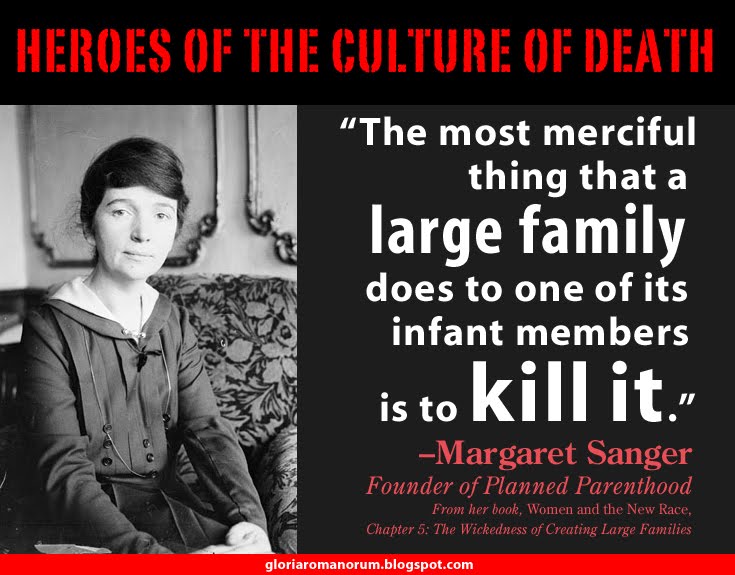
Pictured at the top is birth control pioneer Margaret Sanger, the racist, atheist founder of Planned Parenthood whose motto was “No Gods – No Masters.” The advertisement criticizes the “all male, all-Roman Catholic majority” of the Supreme Court who voted to protect Americans’ religious rights in the case, accusing them of “putting religious wrongs over women’s rights.”

In canonizing Sanger, the FFRF showed its true colors. In addition to being an advocate of racism and eugenics, Sanger advocated infanticide. In her book Woman and the New Race (1920), Sanger seems conflicted on the issue of both infanticide and abortion. In the second chapter, she decries both as “abhorrent practices” and yet criticizes the Catholic church for attempting to stop abortion. In the fifth chapter, one finds the following sentence:

Hobby Lobby Stanger appellate attorney appeals lawyer Pennsylvania

Many have argued that this quote makes sense only when read in context.  Sanger was not advocating infanticide.  She was merely lamenting the horrors that would befall anyone unfortunate enough to be born into such a large family.

Here’s the full paragraph:

Many, perhaps, will think it idle to go farther in demonstrating the immorality of large families, but since there is still an abundance of proof at hand, it may be offered for the sake of those who find difficulty in adjusting old-fashioned ideas to the facts. The most merciful thing that the large family does to one of its infant members is to kill it. The same factors which create the terrible infant mortality rate, and which swell the death rate of children between the ages of one and five, operate even more extensively to lower the health rate of the surviving members. Moreover, the overcrowded homes of large families reared in poverty further contribute to this condition. Lack of medical attention is still another factor, so that the child who must struggle for health in competition with other members of a closely packed family has still great difficulties to meet after its poor constitution and malnutrition have been accounted for.

Id., Chapter V.

Oh the horrors of the tenement.

The seeming ambivalence toward infanticide is more apparent than real.  Sanger argued that there was a natural “evolution” from infanticide to abortion to contraception, with all three stages of fertility-control offering legitimate ways for women to avoid what she called “involuntary motherhood”:

Moreover, if contraceptives proved not to be foolproof, she saw no reason not to fall back on abortion (if it were “skilled”) and infanticide. Indeed, she explicitly approved of mothers exposing their infants in ancient Sparta and Rome, as well as drowning their girl-infants in contemporary China. She regarded the right to kill their infants as evidence of women’s high status in antiquity, and so she excoriated early Christians for replacing infanticide with orphanages. 

Gardiner, Anne Barbeau, “Margaret Sanger’s Multifaceted Defense of Abortion and Infanticide.”  UFFL, Vol 16.

In The Pivot of Civilization (1931), Sanger decries the random and chaotic breeding that has “resulted from our stupid, cruel sentimentalism” and has resulted in the increase in numbers of the “inferior classes.”  The “most urgent problem to-day is how to limit and discourage the over-fertility of the mentally and physically defective. Possibly drastic and Spartan methods may be forced upon American society if it continues complacently to encourage the chance and chaotic breeding that has.”

The reference to Sparta should send a chill down the spine to anyone familiar with the history of civilization. The history of infanticide is gruesome. As hard as it may be to imagine today, throughout history infanticide was a common and endorsed practice. Although it still occurs today, all governments outlaw it. And, in the West at least, society and culture condemn it. So how did we get from there to here? From earlier societies that condoned and encouraged infanticide to a society that condemns and discourages it?

The short answer: Christianity.  And before it: Judaism. Yes, those male Roman Catholic judges decried by the FFRF are heirs to a moral system that transformed ancient civilization by declaring that every human being has an essential dignity.  Yes there have been some bumps along the road.  But think about where we started.

Pagan society approved of infanticide and encouraged it. “Not only was the exposure of infants a very common practice, it was justified by law and advocated by philosophers.” Rodney Stark, The Rise of Christianity, page 118. In Greece and ancient Rome a child was virtually its father’s chattel-e.g., in Roman law, the Patria Protestas granted the father the right to dispose of his offspring as he saw fit. In Sparta, the decision was made by a public official. The Twelve Tables of Roman Law held: “Deformed infants shall be killed” De Legibus, 3.8. Of course, deformed was broadly construed and often meant no more than the baby appeared “weakly.” The Twelve Tables also explicitly permitted a father to expose any female infant. Stark, supra, p. 118.

Leading pagan leaders and philosophers also encouraged the practice. Cicero defended infanticide by referring to the Twelve Tables. Plato and Aristotle recommended infanticide as legitimate state policy. Cornelius Tacitus went so far as to condemn the Jews for their opposition to infanticide. He stated that the Jewish view that “it was a deadly sin to kill an unwanted child” was just another of the many “sinister and revolting practices” of the Jews. Histories 5.5. Even Seneca, otherwise known for his relatively high moral standards, stated, “we drown children at birth who are weakly and abnormal.” De Ira 1.15.

The anti-Catholic screed published by the FFRF demonstrates the real agenda of that organization and its fellow travelers—to send civilization back to paganism.  Get rid of Christianity, especially Catholicism.  Get rid of Judaism, with its “sinister and revolting practices.”  Go back to ancient civilization and allow parents to murder their unwanted children.  All with the blessing of Margaret Sanger.


Posted in Uncategorized

Word Crimes

While I am in my kynetic typography silly season, I couldn’t help but direct your attention to Weird Al’s “Word Crimes” video:


Posted in Uncategorized

The Impotence of Proofreading

While I’m on a kinetic typography kick, I thought I might share an amusing video that demonstrates the difficulty of proofreading one’s own work, even with spell check.  The narrator’s voice is annoying, but his message is clear.


One suggestion: Use  “text to speech” software to read your documents back to you.  Hearing another “person” reading one’s prose is a humbling experience.  Try it; you’ll be amazed at how many errors—especially missing words and sentence fragments—you will catch as the voice reads to you. The best software is manufactured by Ivona, whose voices actually take appropriate pauses and use inflections. (See: http://www.ivona.com/en/).  Both Microsoft Word and Adobe Acrobat products have text-to-speech capabilities, though both use mechanical voices. For free on-line text to speech, use Google Translate (http://translate.google.com/) or From Text to Speech (http://www.fromtexttospeech.com/) or Smart Link (http://www.text-to-speech.imtranslator.net/).

Another suggestion: Hire a proofreader.  I have found Ivy League Proofreaders to be a good value.  Check out: www.ivyleagueproofreaders.com.


Posted in Uncategorized

To blog of legalese

“The time has come,” the lawyer said,
“To blog of legalese:
Of headings—and quotes—and citations—
Of orders and decrees—
And why law prose is frightfully dull—
And whether the brief will please.”

In 35 years, progress?

“There are two things wrong with almost all legal writing. One is its style. The other is its content. That, I think about covers the ground.” Fred Rodell, Goodbye to Law Reviews, 23 Va. L. Rev. 38, 38 (1936–1937) “Legal writing by federal judges and the lawyers who appear before them is today generally serviceable, in the sense of being pretty clearly written, pretty careful, businesslike, grammatical.” Richard A. Posner, Legal Writing Today, 8 Scribes J. Leg. Writing 35, 35 (2001–2002) (emphasis in original).